
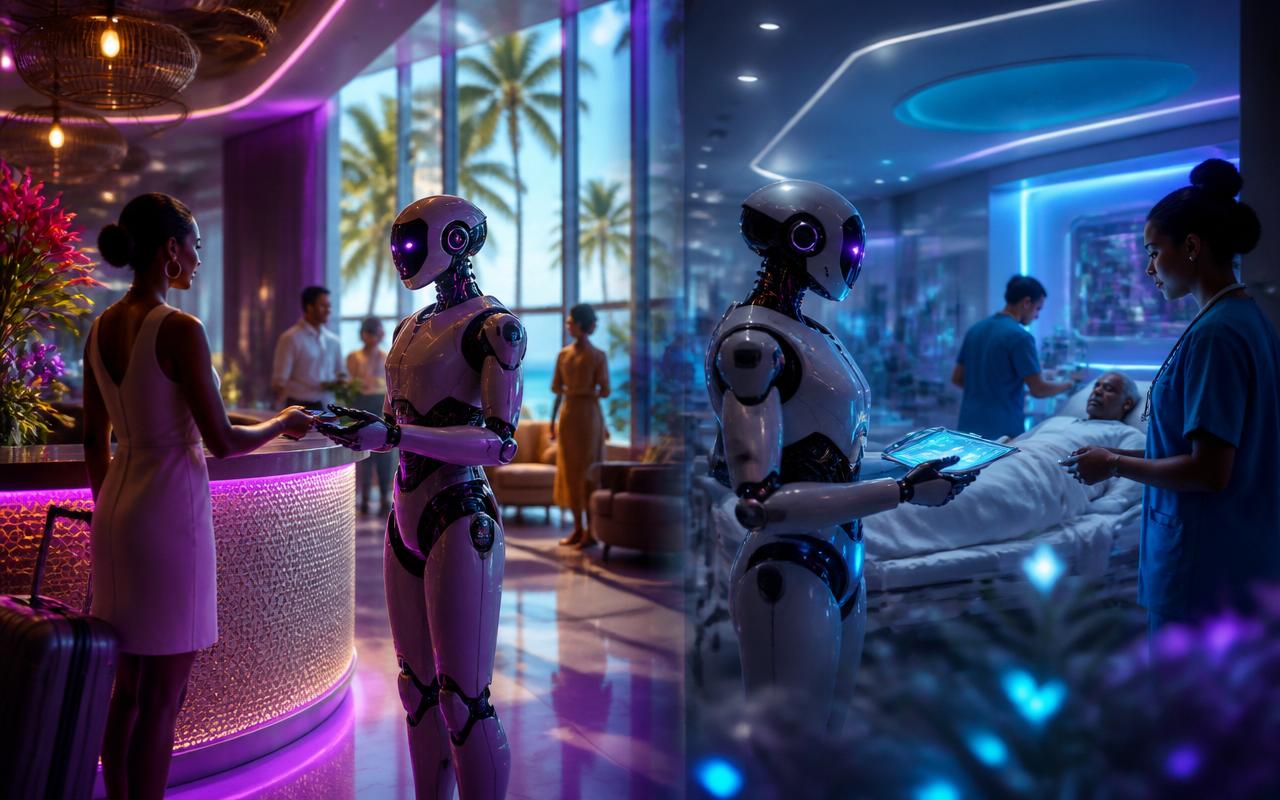
When people talk about robots in Latin America, the mental image is usually an industrial arm in an automotive plant. But the wave arriving today in the Dominican Republic is different: service robots, designed to coexist with people in open environments — hotels, clinics, airports, restaurants — and to handle repetitive tasks that currently consume staff time.
What a service robot is
Unlike an industrial robot, a service robot moves among people, avoids obstacles in real time, and communicates simply — by voice, screen, or light cues. It does not replace the human team; it gives back hours currently lost carrying, guiding, transporting, or checking.
Three families are showing clear results in the country:
- Hospitality: robots that deliver room-service orders, guide guests to their rooms, and carry amenities without tying up the bell staff on repetitive trips.
- Health: logistics robots that move medications, lab samples, and hospital linens between floors, freeing nursing staff.
- Airports and public spaces: information and autonomous cleaning robots that operate overnight and answer common questions in several languages.
Why now
Three factors made this wave viable. First, hardware got cheaper: today a service robot costs a fraction of what it did five years ago. Second, sensors and autonomous navigation algorithms matured: a robot can learn the map of a hotel in a few hours and adapt when furniture moves. Third, pressure on the service sector is real: finding and retaining staff for repetitive tasks is increasingly hard.
Not replacement, amplification
The right reading is not "robots take jobs" but "robots absorb the most thankless part of certain jobs." A hotel server stops going up and down ten times an hour with a tray; a nurse stops walking kilometers a day carrying IV bags. Those recovered hours turn into more time with the guest and the patient.
The challenge is not technological — the robots already work — it is organizational: redesigning workflows, training the human team to operate them, and explaining what to expect to the customer. The Dominican companies taking the lead are not doing it as a fad: they are doing it because they found that service experience improves when technology takes on the repetitive and people are left with the human.